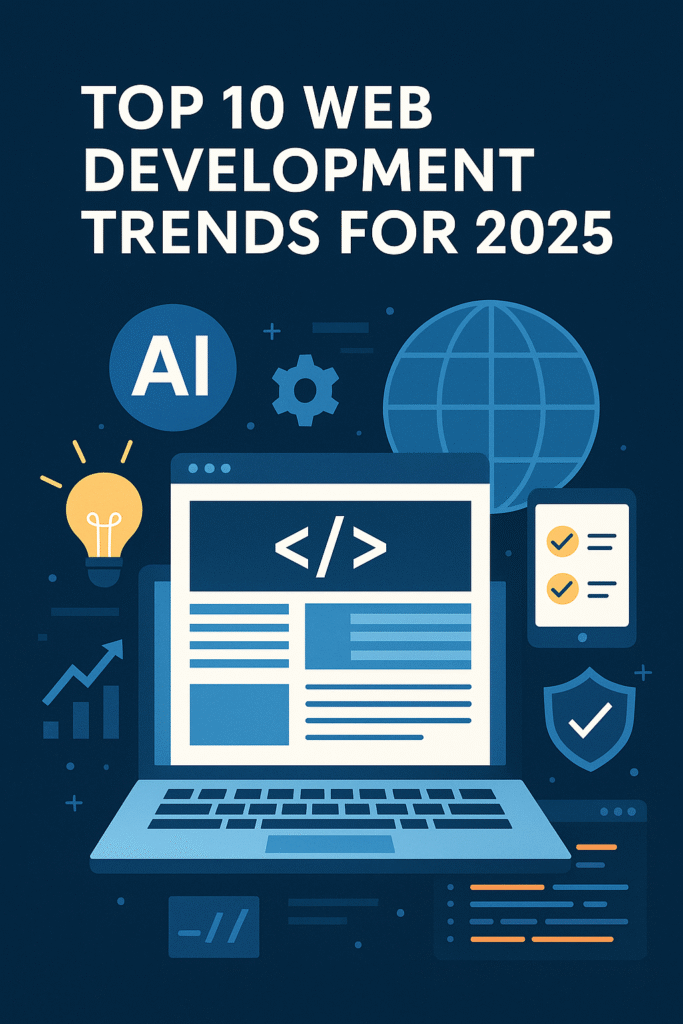
The web development industry is evolving faster than ever. With new technologies, AI-driven tools, and smarter frameworks, 2025 promises to reshape how businesses build and manage their websites.
Whether you’re a startup, enterprise, or digital agency, staying ahead of these trends is key to delivering seamless user experiences and maintaining a competitive edge.
In this blog, we’ll explore the top 10 web development trends for 2025 that are shaping the future of digital experiences — and how your business can take advantage of them.
1. AI-Powered Web Development
Artificial Intelligence (AI) is transforming web development in every possible way — from automating code generation to improving user experience through predictive personalization.
✅ How it’s changing the game:
- AI tools like ChatGPT and GitHub Copilot help developers write efficient code faster.
- Websites are becoming smarter with AI chatbots, voice assistants, and personalized content delivery.
💡 Example: E-commerce sites using AI recommendations see up to 40% higher conversion rates.
2. Progressive Web Apps (PWAs)
PWAs continue to dominate in 2025. They offer the speed and offline accessibility of mobile apps without requiring installation.
✅ Benefits of PWAs:
- Lightning-fast performance.
- Offline usability.
- Cost-effective compared to native apps.
💬 Example: Twitter Lite and Starbucks’ PWA improved engagement and reduced bounce rates significantly.
🎯 Pro Tip: If your business targets mobile users, a PWA can drastically improve conversions.
3. Voice Search Optimization
As voice assistants like Alexa, Siri, and Google Assistant become mainstream, optimizing websites for voice search is now essential.
✅ Voice-ready websites focus on:
- Natural language processing (NLP).
- Conversational keyword integration.
- Quick-loading, mobile-optimized layouts.
💡 Example: By 2025, voice commerce is expected to surpass $30 billion globally.
4. Motion UI and Micro-Interactions
Aesthetics and engagement go hand in hand. Motion UI adds subtle animations, hover effects, and interactive transitions that make websites visually appealing.
✅ Benefits include:
- Enhanced user experience.
- Improved storytelling.
- Higher engagement rates.
💬 Tip: Combine motion design with minimalist interfaces to avoid clutter.
5. Cybersecurity-First Development
With rising cyber threats, secure web development is no longer optional. In 2025, security-by-design will be a mandatory standard.
✅ Best practices include:
- HTTPS encryption and SSL certificates.
- Regular security audits and updates.
- AI-based threat detection systems.
💡 Example: Businesses adopting advanced security protocols report 70% fewer data breaches.
6. Low-Code and No-Code Development
Low-code and no-code platforms are making web development more accessible. Businesses can now build, deploy, and scale web applications without extensive coding knowledge.
✅ Popular platforms:
- Webflow
- Bubble
- Wix Studio
💬 Why it matters: These tools speed up time-to-market and reduce dependency on large dev teams — perfect for startups.
7. Blockchain Integration
Blockchain isn’t just for cryptocurrency anymore — it’s transforming data transparency and digital transactions.
✅ Use cases for web development:
- Secure payments and smart contracts.
- Decentralized apps (DApps).
- Tamper-proof data storage.
💡 Example: Blockchain-backed e-commerce websites offer safer payment gateways and improved trust.
8. Dark Mode and Energy-Efficient Design
Dark mode isn’t just trendy — it’s practical. It reduces eye strain, saves battery life, and looks sleek.
✅ Why brands love it:
- Enhances UX on mobile devices.
- Aligns with modern UI trends.
- Lowers screen energy consumption.
🎯 Pro Tip: Always provide users with a “switch mode” option for flexibility.
9. Headless CMS and API-First Development
Headless CMS solutions like Strapi, Contentful, and Sanity are gaining momentum in 2025.
✅ Advantages:
- Faster content delivery through APIs.
- Greater flexibility for omnichannel publishing.
- Seamless integration with frontend frameworks like React and Vue.
💬 Why it matters: A headless CMS helps businesses manage content across websites, apps, and digital kiosks efficiently.
10. Augmented Reality (AR) and Virtual Reality (VR)
AR and VR are no longer limited to gaming — they’re redefining online shopping, real estate, and education.
✅ How AR/VR enhances UX:
- Virtual product try-ons and tours.
- Interactive training sessions.
- Immersive storytelling experiences.
💡 Example: IKEA’s AR app allows users to preview furniture in their home before buying — increasing purchase confidence.
Final Thoughts
Web development in 2025 is all about speed, personalization, security, and user experience.
To stay ahead, businesses must adopt AI-driven technologies, focus on performance optimization, and invest in secure, scalable solutions.
At DigiAtmos, we specialize in building modern, high-performance websites aligned with the latest web development trends. Our team combines creativity, technology, and strategy to help brands stand out and grow online.
If you’re ready to upgrade your digital presence for 2025, DigiAtmos is your trusted partner for innovation-driven web solutions.
Frequently Asked Questions (FAQs)
Q1. What’s the biggest web development trend in 2025?
AI-driven automation, Progressive Web Apps (PWAs), and cybersecurity-first development are the top trends dominating 2025.
Q2. How can AI improve website performance?
AI helps automate coding, personalize user experiences, and analyze data to optimize site speed and conversions.
Q3. Should businesses invest in AR/VR web features?
Yes, AR/VR enhances engagement and is especially effective for e-commerce, education, and real estate industries.
Q4. Does DigiAtmos provide modern web development solutions?
Absolutely! DigiAtmos offers full-stack web development using the latest technologies and frameworks for future-ready websites.