Today, llmo vs traditional seo differences are becoming one of the most important topics in digital marketing. As AI search, generative AI, and large language models change how people discover information online, businesses need to understand how search optimization is evolving.
For years, traditional SEO helped websites rank on search engines like Google. Brands focused on keywords, backlinks, and technical performance to appear on the first page of results. Now, users are also asking AI assistants direct questions and expecting quick answers instead of browsing many pages.
This shift is changing how businesses attract traffic. Understanding the difference between LLMO and traditional SEO can help brands build a smarter strategy for the future.
What is Traditional SEO?
Traditional SEO is the process of optimizing a website so it ranks higher on search engines. It mainly focuses on making content easy for search engine crawlers to index and understand.
Traditional SEO usually includes:
- Using target keywords naturally in content
- Building quality backlinks
- Improving page speed
- Writing optimized title tags and meta descriptions
- Creating mobile-friendly pages
- Improving site structure and internal linking
The goal is simple: rank higher in search results and bring visitors to your website.
Traditional SEO still matters because millions of users continue to search through standard search engines every day.
What is LLMO?
LLMO stands for Large Language Model Optimization. It focuses on making content easy for AI systems to understand, summarize, and recommend.
Instead of only trying to rank on search engines, LLMO helps your content appear in answers generated by AI assistants.
For example, if someone asks an AI tool, “What is the best CRM software for startups?” the AI may mention only a few brands. LLMO improves the chance that your business becomes one of those recommendations.
This is why AI visibility, semantic search, and conversational search are becoming major parts of modern marketing.
Main Differences Between LLMO and Traditional SEO
The biggest difference is how content is discovered.
Traditional SEO focuses on rankings
In traditional SEO, the goal is to rank a webpage higher than competitors. Success depends on where your page appears in search results.
Users click a result, visit your website, and then explore your content.
LLMO focuses on answers
With LLMO, the goal is different. Instead of only ranking pages, content needs to help AI systems create useful answers.
The AI may summarize your information directly. In many cases, the user may see your brand mentioned before they ever click your website.
Keyword targeting vs search intent
Traditional SEO often focuses heavily on exact keywords.
LLMO focuses more on search intent, context, and natural language. AI models understand meaning, not just exact keyword repetition.
Backlinks vs authority and clarity
Backlinks remain important for SEO.
For LLMO, content clarity, structure, factual accuracy, and authority become even more important. AI prefers pages that answer questions clearly and directly.
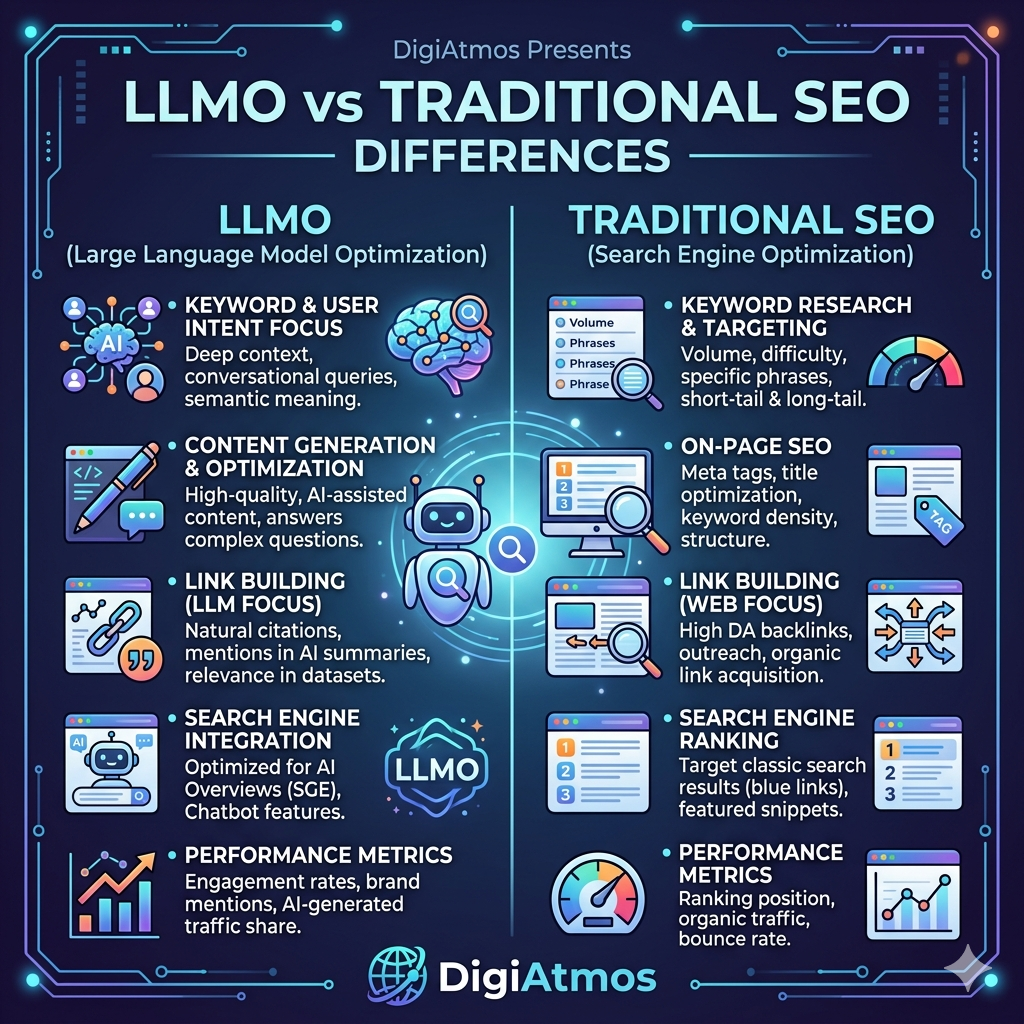
llmo vs traditional seo differences
At this point, llmo vs traditional seo differences become clearer because both strategies aim for visibility, but they work in different ways.
Why Businesses Need Both
Many businesses wonder whether LLMO will replace SEO. The short answer is no.
Traditional SEO still drives valuable organic traffic. Search engines still matter, and ranking pages still creates visibility.
But LLMO is growing because users increasingly depend on AI assistants for product comparisons, quick research, and recommendations.
The smartest approach is to combine both.
A modern content strategy should include:
- SEO-friendly headlines and metadata
- Clear answers to real user questions
- Structured content with useful headings
- Natural language that AI can easily understand
- Helpful blogs, FAQs, and case studies
This combination helps your content perform well in both search engines and AI-generated results.
Which Strategy is Better for the Future?
The future is not about choosing one over the other.
Traditional SEO is still strong for attracting clicks. LLMO is becoming important for being mentioned in AI-generated answers.
For example, if a user searches on Google, SEO helps your page rank.
If the same user asks an AI assistant for software recommendations, LLMO helps your brand become part of the answer.
That is why businesses that adapt early can gain an advantage in content marketing, AI search optimization, and digital visibility.
How to Start Optimizing for LLMO
If you want to prepare your website for AI-driven search, start with simple steps:
Write clearer answers
Use simple language and directly answer common customer questions.
Improve content structure
Use proper headings, short paragraphs, and logical page organization.
Focus on topical authority
Create multiple pieces of content around the same topic so AI can better understand your expertise.
Update old content
Refreshing older blogs can improve both SEO performance and AI relevance.
llmo vs traditional seo differences
In conclusion, llmo vs traditional seo differences show how digital marketing is entering a new stage. Traditional SEO focuses on rankings, keywords, and search engine traffic. LLMO focuses on AI search, context, and being included in smart answers.
The best strategy is not replacing one with the other. It is combining both.
As generative AI continues to influence online search behavior, businesses that understand llmo vs traditional seo differences will be better prepared to attract traffic, build trust, and stay competitive in the future.