In 2025, competition in digital advertising is fiercer than ever. Businesses are spending billions on Google Ads, but only a few truly optimize their campaigns to get maximum results at minimal cost.
If you’re running Google Ads and not seeing the results you expected — don’t worry. You’re not alone. The key lies in effective optimization — understanding what works, what doesn’t, and how to continuously refine your campaigns for higher ROI.
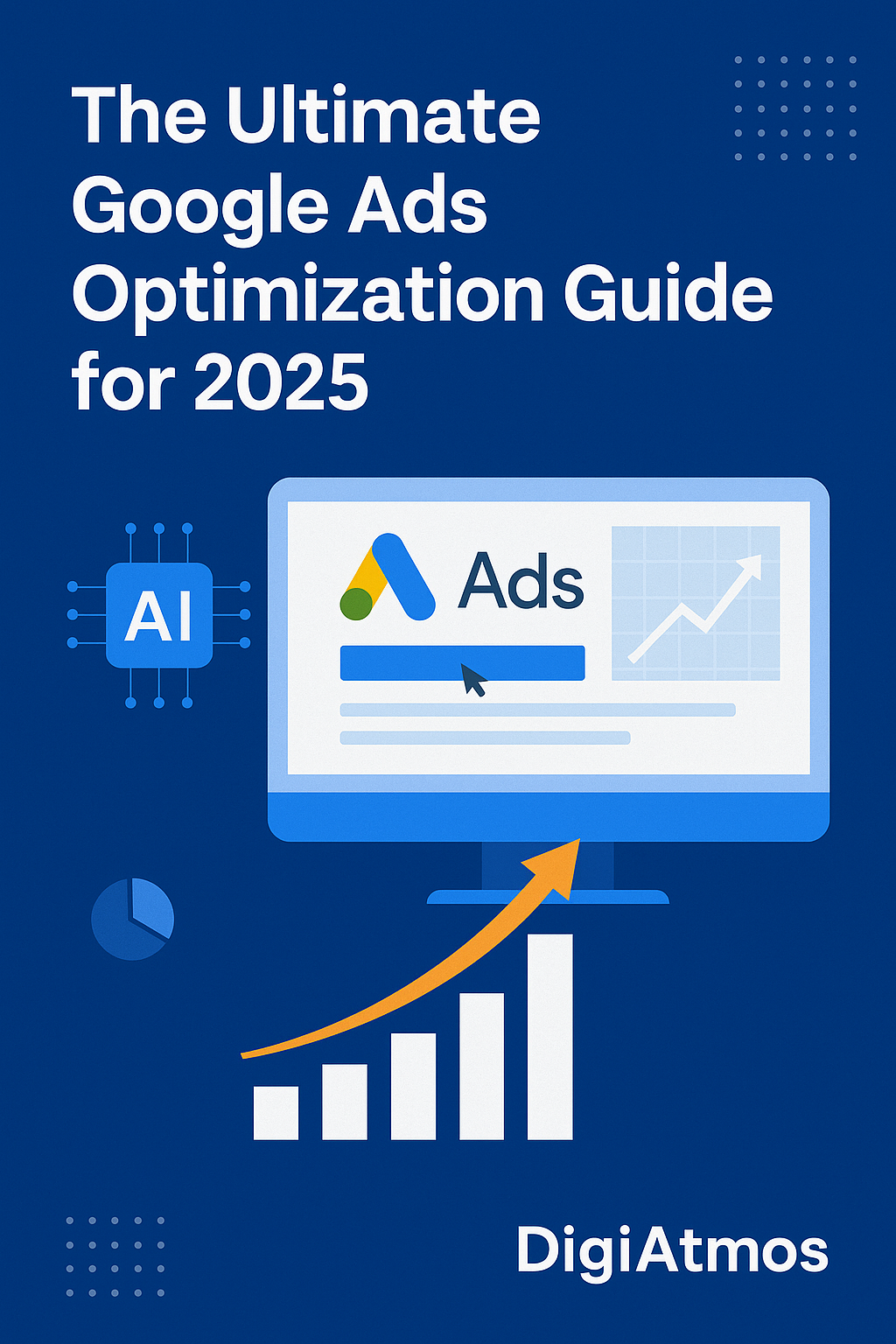
This ultimate Google Ads optimization guide for 2025 by DigiAtmos will help you transform your ad performance with smart, actionable strategies.
1. Start with Smart Keyword Research
The foundation of a successful Google Ads campaign begins with powerful keyword research.
In 2025, it’s not just about targeting high-volume keywords — it’s about focusing on search intent and conversion-focused phrases.
✅ Use tools like Google Keyword Planner, SEMrush, or Ahrefs to identify keywords that match your audience’s buying stage.
✅ Prioritize long-tail keywords — they’re less competitive and more likely to convert.
💡 Example: Instead of bidding on “shoes,” go for “affordable running shoes for men.”
2. Optimize Ad Copy for Click-Through and Relevance
Your ad copy is the first impression — make it count.
Here’s how to create high-performing ad text in 2025:
- Use power words that trigger action — “Get,” “Boost,” “Save,” “Discover.”
- Add emotional triggers like urgency or curiosity.
- Include primary keywords in headlines and descriptions.
- Always have a clear CTA (Call-to-Action) like “Shop Now,” “Sign Up Free,” or “Get a Demo.”
👉 Pro Tip: Use Responsive Search Ads (RSA) to let Google automatically test variations and pick the best-performing combinations.
3. Focus on Quality Score Improvement
Your Quality Score directly impacts both your ad position and Cost-Per-Click (CPC). A higher score means lower costs and better placement.
Google calculates Quality Score based on:
- Ad Relevance
- Expected CTR (Click-Through Rate)
- Landing Page Experience
To improve it:
- Align your ad copy closely with your keywords.
- Ensure landing pages are fast, mobile-friendly, and relevant.
- Remove underperforming ads and focus on those with strong CTR.
4. Use Ad Extensions Strategically
In 2025, Ad Extensions are more powerful than ever — they enhance visibility and encourage engagement.
Top-performing extensions include:
- Sitelink Extensions – Direct users to specific pages.
- Callout Extensions – Highlight offers like “Free Shipping” or “24/7 Support.”
- Structured Snippets – Showcase product or service categories.
- Call Extensions – Let users directly call from the ad.
💡 Tip: Always customize extensions for different campaigns to increase CTR and relevance.
5. Leverage AI & Smart Bidding Strategies
Google’s AI-driven Smart Bidding tools have evolved significantly. In 2025, using these features smartly can skyrocket your campaign performance.
Popular Smart Bidding options:
- Target CPA (Cost Per Acquisition)
- Target ROAS (Return on Ad Spend)
- Maximize Conversions
- Maximize Conversion Value
These strategies use machine learning to automatically adjust bids based on user behavior, device, time, and intent.
👉 Combine automation with human oversight — review data regularly and fine-tune for accuracy.
6. Improve Landing Page Performance
Even the best ad won’t convert if your landing page isn’t optimized.
Here’s what to ensure:
✅ Fast loading speed (under 3 seconds).
✅ Mobile responsiveness.
✅ Clear headlines and concise copy.
✅ Strong CTA (Call-to-Action).
✅ Trust signals (reviews, certifications, testimonials).
💡 Pro Tip: A/B test your landing pages to see which layout or messaging drives more conversions.
7. Analyze & Optimize Regularly
Optimization is a continuous process — not a one-time setup.
Use Google Analytics and Google Ads reports to monitor:
- CTR (Click-Through Rate)
- CPC (Cost-Per-Click)
- Conversion Rate
- ROAS (Return on Ad Spend)
Pause underperforming keywords, adjust bids, and focus on high-converting ad groups.
💡 Set a weekly review schedule to ensure consistent improvement.
8. Retargeting: Don’t Let Potential Customers Slip Away
In 2025, retargeting remains one of the most powerful optimization techniques.
Show your ads to people who have already visited your website but didn’t take action.
👉 Example: If a visitor browses your product page but doesn’t buy, show them a discount offer ad later through Google Display Network or YouTube.
This increases brand recall and improves conversion rates significantly.
9. Keep Up with Google’s Latest Updates
Google Ads constantly evolves. In 2025, updates in AI targeting, privacy policies, and ad formats mean staying updated is essential.
Follow Google’s official announcements and rely on experts like DigiAtmos to adapt your strategy to every new change.
Final Thoughts
Google Ads optimization is the key to maximizing ROI and achieving consistent business growth. The more you refine, test, and adapt, the more successful your campaigns will be.
Whether you’re a startup or an established business, optimizing your Google Ads campaigns helps you attract better leads, lower costs, and dominate the competition.
At DigiAtmos, we specialize in data-driven Google Ads optimization that helps businesses stay ahead of the curve in 2025 and beyond.
Frequently Asked Questions (FAQs)
Q1. What is Google Ads optimization?
It’s the process of improving your campaigns by adjusting keywords, bids, ad copy, and landing pages to boost performance and ROI.
Q2. How often should I optimize my Google Ads campaigns?
You should review and optimize at least once a week to track progress and adjust based on performance data.
Q3. Can AI improve my Google Ads campaigns?
Yes, Google’s AI-powered bidding and targeting tools in 2025 are smarter and help improve conversions and reduce ad costs.
Q4. What is the biggest mistake in Google Ads optimization?
Ignoring data. Failing to analyze reports or optimize based on insights can waste ad budget and lower ROI.
Q5. Does DigiAtmos provide Google Ads optimization services?
Absolutely! DigiAtmos offers complete Google Ads setup, optimization, and management tailored for 2025 digital marketing trends.